
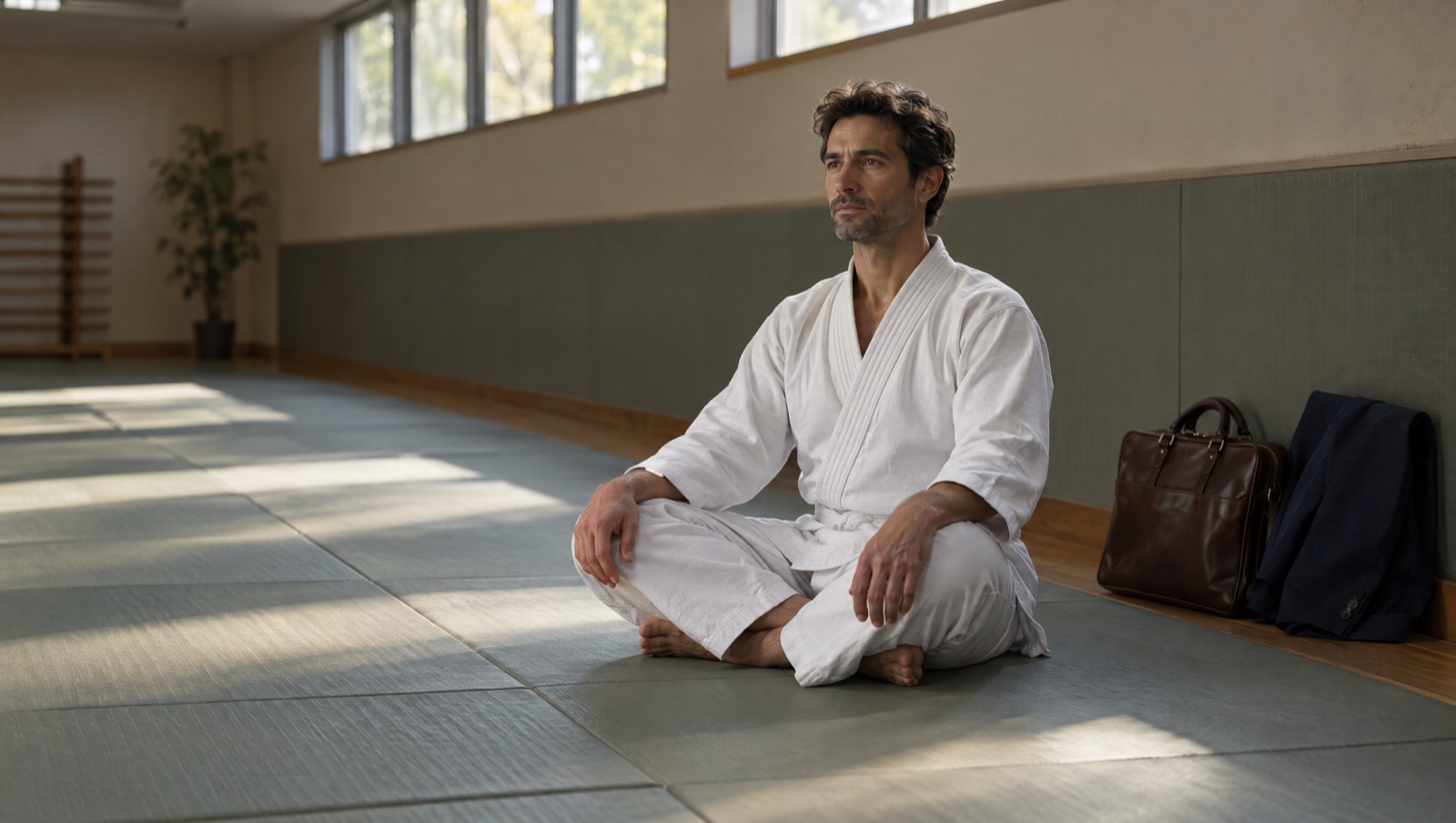
A martial arts mindset is a trained way of handling discomfort: you show up on schedule, you stay composed when something hard is coming at you, and you keep your attention on the next move instead of the scoreboard. You do not need a black belt to use it. The habits that keep someone steady on the mat work just as well in a tense meeting, a hard conversation or a week where everything lands at once.
This guide is for the driven professional who wants the mental side without the mouthguard. It covers what the mindset actually is, how it handles discipline, fear and focus, and how to practice each one at work and at home.
What is a martial arts mindset?
Strip away the uniforms and the ceremony and a martial arts mindset comes down to one relationship: you and honest feedback. On the mat, you cannot talk your way out of a bad position. Either your technique works on a resisting partner or it does not, and you find out within seconds.
That feedback does something useful to your ego. It shrinks. People who train for a while stop treating every mistake as a verdict on who they are and start treating it as information about what to fix next. They expect to be bad at something new, and they keep going anyway.
Notice what is missing from that description: aggression, chest puffing and the tough guy act. The mindset is about control. Composure, patience and repetition do most of the work, and they are exactly the qualities many high achievers lose when the stakes go up at work.
Discipline: train on schedule, not on mood
Class starts at the same time whether you feel ready or not. That simple fact teaches more discipline than any speech. You do not ask yourself on a Tuesday night whether you are in the mood to train. The decision was made when you put it on the calendar, so the only question left is whether you keep your word.
Rank works the same way in most arts. It reflects accumulated hours, and those hours are mostly ordinary. Nobody earns a belt in one great session. They earn it in hundreds of average ones where they showed up tired, did the drills and went home.
Off the mat, this is the difference between people who wait to feel motivated and people who have already decided. If you want to see why waiting for the right mood keeps you stuck, read why discipline beats waiting for motivation.
The practical move is simple: pick the two or three things that matter most this season, give them fixed times, and treat those times like class. You can be late to plenty of things. You do not skip class.
Respect the drills, too. Martial artists repeat the same basic movements for years because fundamentals are what hold up under stress. For you that might be the weekly planning hour, the daily walk or the first focused block of the morning. Boring and repeated beats impressive and occasional.
Fear: train with it, not around it
Every martial artist learns this early: fear does not leave first. You step in to spar with your heart pounding, and it keeps pounding for a while. What changes is not the feeling but your ability to think and move while it is there.
Good training handles fear with dosage. A beginner does not start with hard rounds against the most experienced person in the room. They start with light drills, then controlled rounds, then harder rounds as their skill catches up.
In grappling arts there is even a built-in exit: you tap, you reset and you go again. Losing a round is a normal part of the day, not an emergency.
Now look at the fears that actually run a professional’s week: the conversation with a business partner you keep postponing, the feedback you owe someone on your team, the pitch to a bigger client, the boundary you have not set with your own calendar. Most people treat each of these like a fight they must win in one shot, so they avoid it entirely.
Use the mat approach instead. Start with a lighter round: say the hard thing to one trusted person before you say it to the room. Rehearse your first sentence out loud.
Take on a lower-stakes version this week and the bigger one next month. Afterward, debrief what worked rather than replaying what went wrong. For the moment itself, read how to perform under pressure instead of fearing it.
Focus: the three states of mind in martial arts
Traditional Japanese martial arts give names to the mental states practitioners work toward. You do not need the vocabulary to benefit, but the names are useful because each one maps cleanly onto a problem busy professionals have.
- Mushin, the empty mind. Acting without the running commentary. On the mat, hesitation gets you caught, so you train until the right response happens without a debate. At work, mushin is what you get when you prepare thoroughly and then stop narrating yourself during the presentation. The thinking happens before, not during.
- Fudoshin, the immovable mind. Staying steady when something unexpected hits. A partner changes the angle, and you adjust without panic. In a meeting, it is hearing the curveball question, taking a breath and answering it instead of letting it knock the rest of your plan off course.
- Zanshin, the remaining mind. Staying aware after the action ends. A technique is not finished the moment it lands, so you stay alert to what comes next. Off the mat, zanshin is the follow-up email, the notes you write after the call and the check-in a week later. Plenty of dropped balls happen right after someone decides they are done.
None of this is mystical. These are attention skills, and like any skill they improve with reps. Pick one this week.
If your meetings get derailed easily, practice fudoshin. If things fall through the cracks, practice zanshin. If you freeze in the moment, the fix is usually more preparation before the moment, which is where mushin comes from.
Frequently asked questions
How does martial arts change your mindset?
It changes how you read discomfort and mistakes. Training gives you honest feedback within seconds, so you learn to treat a bad round as information instead of a verdict on who you are. With steady practice you get used to showing up on schedule, staying composed under pressure and fixing one thing at a time instead of waiting to feel ready.
Do you need to train martial arts to have a martial arts mindset?
No. Training is the fastest place to practice it because the feedback is immediate, but the principles work anywhere. Fixed training times, small doses of controlled discomfort, honest debriefs and steady attention under pressure can all be practiced at work and at home. The mat simply makes the lessons hard to ignore.
Can martial arts help with discipline?
It can, mainly because training is built around showing up on a schedule and repeating fundamentals whether you feel like it or not. That structure turns discipline into a habit rather than a feat of willpower. The lesson only carries into the rest of your life if you deliberately apply the same structure to your work, health and relationships.
What lessons from martial arts apply to business?
Put your most important work on fixed times and keep them like class. Build skill through fundamentals you repeat, not occasional big efforts. Take on hard conversations in measured doses, starting with a lower-stakes version. Then stay alert after the action ends, because the follow-up email, the call notes and the check-in a week later are where dropped balls get caught.
Bring the martial arts mindset into the rest of your life
Discipline, fear and focus are not three separate projects. They are one way of operating: decide in advance, step into hard things in measured doses, and keep your attention on the next move. Growth on the mat compounds one ordinary session at a time, and it works the same way from LVL 1 to LVL 99 in your career, health and relationships.
Jeff Nelson, the coach behind Level 99 Mindset, is a martial artist and entrepreneur turned mindset strategist. If you want someone in your corner while you apply this to your own week, start with 1-on-1 mindset coaching and a free discovery call. If you would rather see where your gaps are first, take the Life Assessment and rate all ten areas honestly.
Leave a Reply